
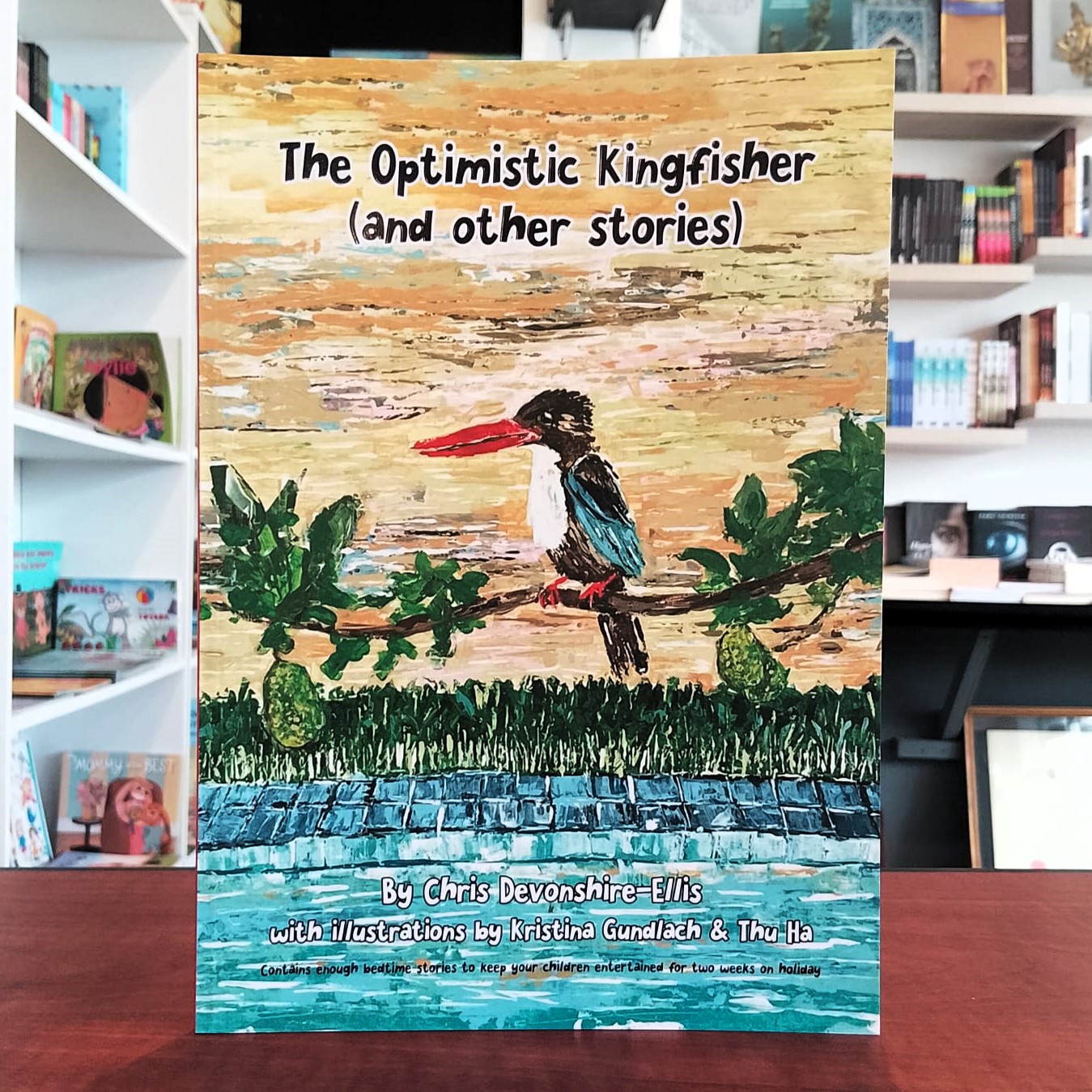
Chris Devonshire-Ellis works in the field of foreign investment. However, he has also been a writer for many years. Chris used to write for music magazines and interview jazz and soul musicians, including well-known artists such as Luther Vandross and George Clinton. He has also written several business books and expat stories about living in China, along with a travel guide to Mongolia. However, “The Optimistic Kingfisher” is his first collection of children’s stories published by The Jam Fruit Tree Publications.
“This book came about when I had some young Russian children staying with me in Sri Lanka a few years ago, and I entertained them by writing stories. They loved these stories so much and used to have them read to them before they went to sleep. With the pandemic, it wasn’t until recently that I decided to revisit those stories, get in touch with some artist friends of mine, have them illustrated and then published,” said Chris. “The Jam Fruit Tree Publications did a fantastic job of making these stories really come to life in print form.”
The stories in his book are about animals and birds of Sri Lanka, different fish, whales, turtles, etc. And with the illustrations, it’s almost like a children’s guide to the natural world of the island. Chris noted how children also have their fears and are scared of creepy crawlers. Therefore, in his book, there are stories about different types of insects explaining if they’re good or bad and what to do when you encounter them. It’s about not being afraid to go outside and experience the great beauty of the outdoor life Sri Lanka has to offer. It’s educational but also fun.
The Optimistic Kingfisher is written from the perspective of an adult and for the mother or father reading these stories at bedtime. Since it’s written for adults to read to their children, Chris mentioned how he also put in some jokes which may fly over the heads of young children, but adults would find quite entertaining. It also follows the environment that Rudyard Kipling managed to portray in his books, such as “The Jungle Book”. “There are three kinds of love in the book. One is the love of Sri Lanka and explaining what it is all about. One is the love of children and introducing them to Sri Lanka, especially the foreign children here. And the other is my love for my dogs: Clemmie and Winnie, whose adventures are also featured in the book,” said Chris fondly. “Therefore, it’s a love story to my dogs, to Sri Lanka and to young children everywhere. Hopefully, people would agree with those sentiments.”
The stories are set in Sri Lanka since Chris moved here around thirteen or fourteen years ago. He purchased a bungalow in Unawatuna, travelled around, became familiar with the country, swam in the sea and visited all sorts of places. “I’m fortunate to have a big garden there, which was redesigned by Geoffrey Bawa’s ex-gardener with a beautiful pond. So a lot of the stories about the flowers and the birds are based upon what the children and I saw in that garden. Therefore, these are written from a home perspective,” said Chris.
Being partially retired, Chrish now considers that reading a fun children’s book set in Sri Lanka is much more interesting than legal reports. Therefore, his future career as a writer would be geared more towards fiction. He’s hoping to write a sequel to this book as well, depending on how it would be received by the people. The author also mentioned that he has ideas for books that might be more appealing to adults in Sri Lanka as well.
The title story of this book, The Optimistic Kingfisher, was about a kingfisher who used to sit on a jasmine branch overlooking the author’s fishing swimming pool at nine o’clock in the morning. Obviously, there was no fish in my swimming pool, so Chris saw it as an optimistic kingfisher. Another example is the story of Clemmie’s pond, which was completely covered in water lilies, into which one of his dogs fell, assuming that she was stepping onto grass as it looked green and solid. The author recalled these moments as fond and funny memories. Such authentic and amusing incidents that happened were his muse as he expanded and developed those themes within each particular story.
“Once you turn on your creative mode, the ideas flow. Once the brain is engaged and you are in that zone, the stories just come out,” said Chris. “Particularly when I’m writing, I don’t like to be disturbed. I want to be alone to concentrate on the story. My wife is very tolerant, the dogs are kept away, and my phone is turned off. In terms of publishing, Jeremy Muller at The Jam Fruit Publications was very helpful. We arranged everything online since, at the time, I was out of Sri Lanka.” The author explained how his publisher helped with the layout and the proofreading: grammatical and spelling mistakes, which were inevitably cleared out with his competent team. “They specialise in giving a platform for new authors to try their hand at writing. The publishing process was easy, simple and very clear. What could have been a difficult and complicated situation was made seamless through the local support of The Jam Fruit Tree Publications,” mentioned the author.
Another important aspect of this book is that it’s heavily illustrated with a lot of paintings and drawings of animals and nature. He mentioned how it was a lot of fun to arrange and how he’s fortunate to have a very talented artist. “Sri Lanka is a very literate country and always has been. Therefore, if anyone reading this has a book inside of them that they need to get out, do sit down and write. Get your muse in place, let the stories come out, make it into publication format and get it out there,” encouraged the author. “People kept asking when I’m going to publish it, so it was great fun when I actually decided to publish the book. I finally got the stories out of hibernation and re-read them. Hence, rediscovering stories which I had written several years ago and refreshing my memory was really enjoyable.”
Chris explained that there is a vital, underlying message in the book, and that is for children not to be afraid of nature since it can be rather frightening. Sri Lanka is an island, and there’s a big ocean out there. There are all sorts of fish and sharks, and on land, there are snakes and scorpions and animals that bite and buzz and sting. The book encourages not to be afraid of any of these, but for children to realise that it’s just part of nature. What’s important is finding out what these are, what they do and which ones we should be a little careful of and look out for. The author explained how it’s almost like a natural history guide at a very junior level, as the purpose is to educate our children to start taking notice of birds, flowers and animals and ask themselves questions about them. “Maybe one day, they will grow up to be adventurous themselves and continue that tradition of encouraging children to enjoy nature, admire animals and be outdoors more often,” said the author.
Words by Gayanga Dissanayake