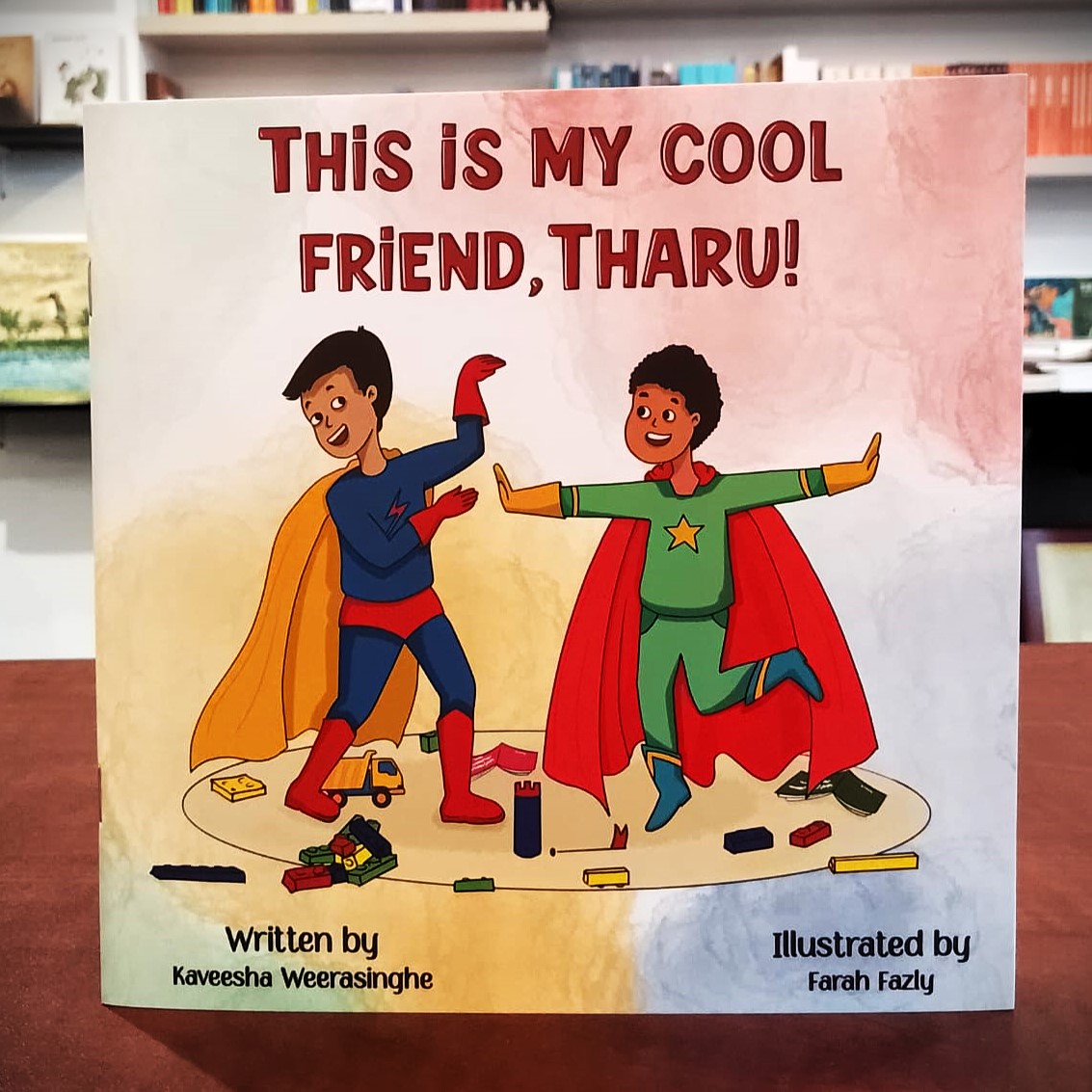
“To be a writer, I was mostly inspired by my grandmother. She was a great storyteller. I remember the stories she used to tell me when I was about three years old,” said Kaveesha Weerasinghe. “Every day she would make up stories so that they really expanded my imagination.” Kaveesha was actually into creative writing since she was very young. Since she was around six or seven, she has been writing in both Sinhala and English. Even though she didn’t do literature for her A/Ls, the writer in her never died. As testimony to that, Kaveesha is now the published author of This is my cool friend, Tharu!, a children’s book published by The Jam Fruit Tree Publications.
Incidentally, Kaveesha was looking for extra cash while she was studying. Her father was in marketing, and he had some contacts at a research company where she started working. Research, she explained, also means a lot of writing, including analysing and understanding human behaviour. “I consider myself lucky to have been exposed to all of that at a very young age,” reflected Kaveesha. “Up until then, I lived a very sheltered life, didn’t go much for classes and spent time mostly at home. Only after getting into research, I was able to broaden my horizons, get to know about different people, different communities, different social strata, their problems and their challenges.” This taught Kaveesha to start looking at everything from different perspectives and in a more empathetic manner, which reflects in her writing now.
This is my cool friend, Tharu! is inspired by the author’s son, who is neurodivergent. Even before he was diagnosed, Kaveesha knew a bit about neurodiversity but not much in detail. “I never needed to know. Only when one is facing something do they get the urge to know about it. Therefore, after the diagnosis, it got me to really research neurodiversity,” said Kaveesha. She took his son to about ten therapists, and each of them told her different things. They gave remarks such as, “If his speech doesn’t come before five, he will never speak.” Kaveesha knew it can’t be right and therefore wanted to do her own research since she knew there was so much more to it.
The author explained how everyone speaks of neurodiversity as an illness or disease. And they only talk about the limitations and not about their capabilities. While she was doing her own research, she came across a Facebook page “Parents of Autistic Children’s Group”, run by a mother with an autistic daughter, the same age as her son. It was a support group for parents where everyone would share their experiences, and a lot of knowledge sharing took place.
In that group, Kaveesha got to know that there is a large number of children like hers who are denied a lot of opportunities, including not being able to get enrolled at school, which is a basic human right in Sri Lanka. Some parents are afraid to take their neurodivergent children outside into social settings. One reason is fear of judgment, and the other reason is that it is difficult for the neurodivergent child who may experience sensory overloads and unnecessary attention from those around them due to certain behaviours like stimming.
“In countries like ours, even if you have a neurotypical child, a lot of people still pass insensitive remarks. Worrying about their future is another problem because some neurodivergent children have limited movement and are prone to more diseases. So the anxiety of what might happen if we are not there for them in the future is a constant fear,” explained Kaveesha. But she also noted how children are actually much better at accepting differences compared to adults and are much more helpful. She noticed that it’s the adults who condition the children into believing that neurodivergent children are not good to be associated with. This is the notion which she mainly wanted to break.
All of this encouraged Kaveesha to write This is my cool friend, Tharu! Kaveesha recalls that it took quite a long time to see the completion of it because she wanted to be sensitive to the people who were reading it and didn’t want it to sound like a research paper as well. “I also wanted to get the tonality right. I didn’t want to offend any particular group of people, and I didn’t want to glorify neurodiversity either. It’s not a label that you have to wear for the rest of your life. Everyone is more than their neurodiversity. Unlike other disabilities, neurodiversity isn’t exactly something we can see. Sometimes, only while living with them, you’ll realise that they are a little different,” the author said. The book is about accepting yourself and your uniqueness. Kaveesha’s book shines on the fact that neurodivergence isn’t a disability; it’s just how your brain works. This story is all about making life easier for everyone.
Being a neurodivergent child doesn’t mean they can’t function in the normal world. Kaveesha explains how they actually want their children to be able to look after themselves and be independent one day. One of the challenges Kaveesha faced while writing her book was struggling to put everything into twenty-four pages. It was not going to work. She had to focus on one neurodiversity, which is why, at the end of the book, she explains it as an umbrella term under which different kinds of neurodiversity can be found and where she debunks most of the misconceptions and harmful taboos surrounding it.
“This book is about a child who is on the autism spectrum. There’s a lot of discussion but also a lot of misinformation about this subject. Even when modelling the characters, I’ve tried to take different behavioural traits of children, such as different kinds of stimming. These children have to feel accepted, which would help them to function in a neurotypical world more easily. Because let’s face it, this world is mostly built for neurotypical people by neurotypical people. So we can’t change everything. But neurodiverse people should be accepted, supported and welcomed,” said Kaveesha. Hence, her book, This is my cool friend, Tharu!, is a heartwarming message to the children and the parents, to teach and encourage youngsters to choose empathy and understanding from a younger age in order to make the world a better, happier and kinder place for everyone.
Words by Gayanga Dissanayake