
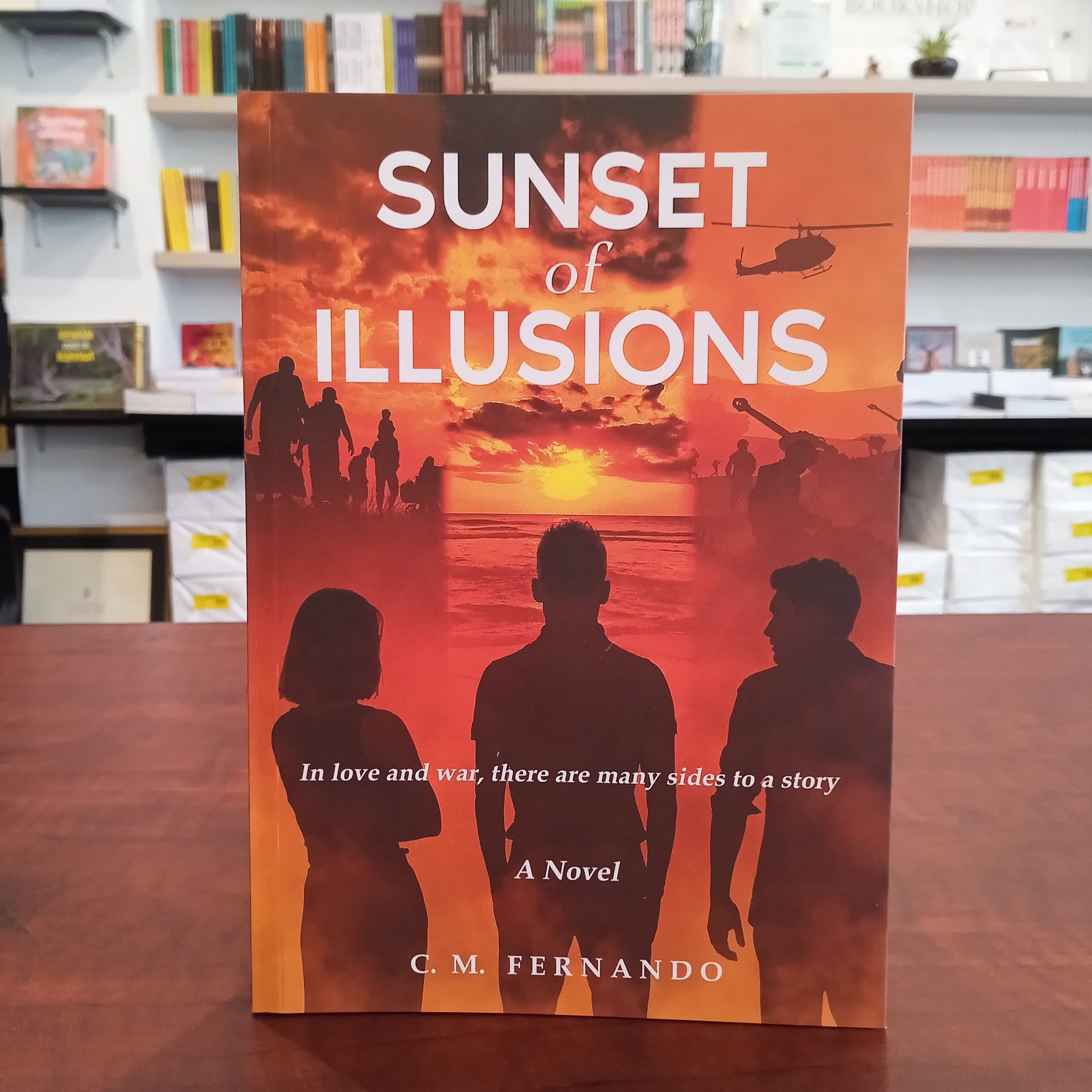
Both academically and professionally, Manilka Fernando has been a logically inclined person, and has been writing articles and other professional content for magazines while he was working both locally and abroad. But most of them were relatively short articles on matters of professional interest. Manilka’s background, however, is in finance and he has been in the banking industry for around forty years. Today, he is also the author of “Sunset of Illusions”, an enthralling story of friendship and passion, set against the volatile backdrop of war.
Manilka did his master’s degree in the USA and knew he had an ability to write, but this book was not something Manilka really thought of pursuing. “The subject of this book is the conflict that took place in this country for over twenty-five years. I’ve read books from ancient civilisations about war and conflict, and had an interest in it since I was young and thought of writing my own book with my own experiences,’ said the author.
Therefore, both his interest and exposure to contacts with knowledge in this area naturally make him a good storyteller of wartime in Sri Lanka. ‘When the COVID lockdown happened, I was sitting at home thinking what to do. I was just locked up and doing basic things. That’s when I thought I’d write a book. This book was initially going to be something professional, likely on business. Then I decided to do some creative writing instead and write fiction. Obviously, it was going to be about the war since I had no other subject in mind. With all my personal experiences, vivid memories and painful observations surrounding the conflict that impacted Sri Lanka for decades, it was very clear to me that this is what I should write about,’ said Manilka.
The author recalled coming across a concept during his studies called “relativism”, which explains that there are multiple realities to any situation. Even the smallest event would be perceived differently by different people. ‘So many of us have differing viewpoints, and when these are rigidly held, they promote conflict. This means there are multiple realities to everything, and this concept is what inspired the plot of my novel,’ said Manilka. The author thinks that understanding this is important because many people get biased in their opinions. He believes that learning to put yourself in the other person’s shoes and looking at their story from their perspective is highly important to solving any conflict. And this, he believes, applies to any conflict. From a small argument at a table to a war.
One major aspect that the author brought out in “Sunset of Illusions” is that friendship can last even if you have completely different opinions on something, and that this power of friendship can override any conflict. Some of the painful experiences and challenges that the characters go through in the novel are based on real situations that the author had to experience himself while living abroad as well. Likewise, almost every character that appears in his book are amalgamations of himself or people that he has met and known. ‘I made it clear in my novel that friendship is more important than all of these external pressures to divide us and how nothing can harm actual connections,’ said the author.
Manilka had to spend a lot of time learning how to write a book. First, as a naturally logical person, he researched how to write. He reviewed videos, books, and everything he could find on writing. He kept reading continuously until one day he was able to write a novel. ‘In fiction, almost every story, other than some notable exceptions, follows a standard structure. So, I also tried my best to master the art of writing until there was a clear plan in my head that I could follow. I had to identify the beginning and the end of my novel and all the major incidents as well,’ said Manilka. According to these theoretical concepts, Manilka learnt that there are two methods to write. One is you plot the entire story and write starting from here and ending there. It’s similar to a formula which one can follow. The second method is having a general idea and just starting to write which will develop along the way. ‘If you are a very creative person, you probably use the second method. I, being a banker, more logical than creative, took the first route. I sketched the plot roughly, and everywhere else, I improvised,’ said the author.
According to Manilka, this book is a twenty-two-year story, and he knew which points he wanted to highlight. ‘It kind of falls into place, and then you write with whatever creativity you have around that structure.’ Manilka recalled how it took five and a half years to finish writing the book. Sometimes, for many months, there was no progress in the manuscript, and there were huge gaps with no productivity in between as well. ‘Sometimes you write almost a chapter in one shot, and sometimes you write only two pages at a time. Usually, mornings are perfect to write because you wake up with a fresh mind and ideas flow easily. If it’s not a busy day or if there’s time to sit down and think, I would sometimes write in the evening as well,’ explained Manilka.
The author explained how there were definitely situations when he felt like he couldn’t balance work and writing with his endlessly busy life. But the joy he felt after he became an author and had people from his childhood approach him and appreciate his work is forever treasured and brings humble pride to him. He also mentioned how young people of today aren’t very informed about this era in Sri Lanka. Therefore, one of the driving forces for him to publish his book is for the younger generation to understand this part of our history a little bit more. ‘The root of these issues is the same, and if our youngsters aren’t aware of this history, we will see them repeating these mistakes in the future. Knowing the story helps them not repeat history again. Therefore, the younger generation needs to know more and consciously learn on purpose. People generally aren’t motivated to do any research, so I thought that by reading a book of fiction, it would trigger readers to do that necessary research and feel the need to know what happened, how it happened and why it happened. That’s my intention with Sunset of Illusions,’ said the author.
Written by Gayanga Dissanayake