
“Music has always been a big part of my life. I started learning the piano when I was four, but even before that, music and teaching were constants in our home.”
Tehani Tissera’s journey as both a musician and a writer is deeply intertwined. She explains how, ever since she was four and started taking piano lessons, while witnessing both her mother and grandmother teach piano, music has always been an ever-present part of her life.
She grew up constantly surrounded by music teachers, which taught her “the best way to teach kids music.” Tehani firmly believes that by immersing kids in the subject and making it part of their everyday lives, she will be able to encourage them to fall in love with music rather than making lessons “an everyday chore.”
What motivated you?
When Tehani was preparing for her LRSM in Piano, part of the requirement was to justify her repertoire during the viva. At the time, she was studying under Mrs Ramya De Livera Perera, and spent a great deal of time researching the composers—their lives, their motivations, and the context in which they wrote the pieces she was performing.
It was this process that helped her connect more deeply with music. “It wasn’t just about playing the notes—it was about understanding the story behind them and the person who wrote it.”
Another predominant source of inspiration for Tehani was her three-year-old daughter. After having a child of her own, she asked herself, “How can I make this subject more accessible to her daily?”
It was this rhetoric that sparked the idea for a children’s storybook. She remembers wanting to create something “kids could carry around, flip through, and connect with—even if there wasn’t someone there to read it to them.”
Why Beethoven as a protagonist?
When asked about her main character—Beethoven—Tehani reveals that “he was the first composer [she] remembers as a kid.” She also felt that it would be easier for children to connect with him as some of his famous pieces, such as ‘Fur Elise’ and ‘Symphony No 5’, can be easily found in cartoons and in their everyday surroundings—most notably, from Sri Lanka’s own Choon Paan uncles.
What was your writing process like?
Tehani describes how she spent a good portion of her time being overwhelmed by facts about Beethoven’s life, but deems it both a “gift and a challenge.” She was determined that all the information in the book be fact-checked while providing a more “holistic view of the subject.” She wanted her book to be multidimensional—revolving around Beethoven’s life, while also touching on the history of classical music.
Tehani also mentions the valuable role her husband played in the process. Having no formal background in classical music, his perspective became crucial to viewing her manuscript through unfamiliar eyes.
“This was crucial to me as my target was to reach kids and families who were curious about classical music but did not know where to begin,” Tehani emphasises that she wants her book to be enjoyed by any age group. She mirrors off her own experiences as a parent who was more likely to pick up a book to read to her daughter, if it had more “rhyme, rhythm and a sense of playfulness.” Thus, in her own novel, she has made sure that the language was musical in itself; therefore, even the facts come across as a story.
Relating to her desire to make reading and education feel less like a chore and more accessible, Tehani has ensured she created a character who is relatable. “Someone to act as a bridge between the past and the present.” She wanted someone to ask questions about Beethoven, making children feel like he was sharing his story with them, instead of dictating a history lesson. Thus, her main character, ‘Marnie’, was born.
What aspects did you focus on in the book?
While Tehani mainly centres her narrative around Beethoven, she has also included a sneak peek into the broader history of Western Classical Music. She aimed to provide a window that enables children to get a sense of what life was like during this time and how the world of classical music functions and evolves.
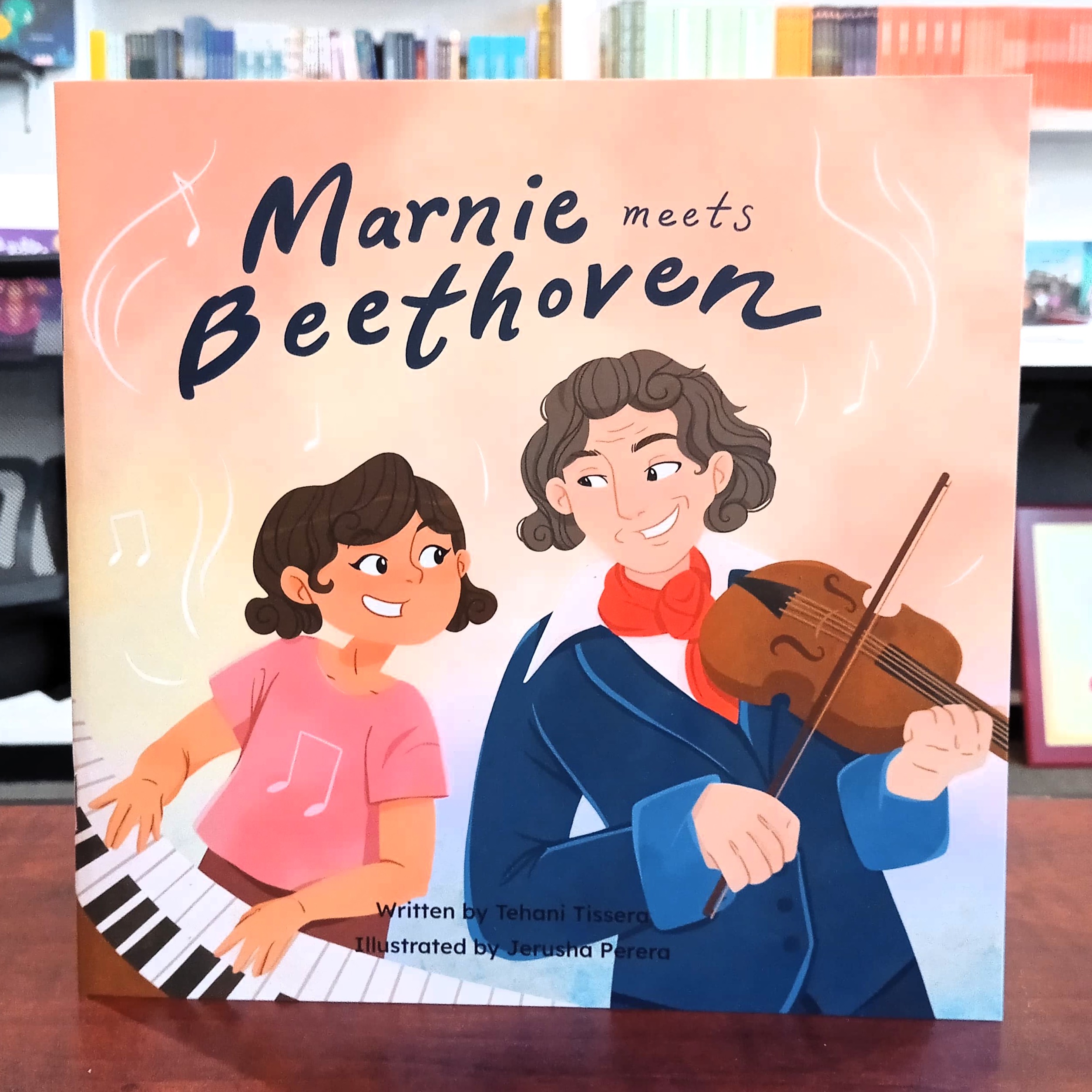
Another aspect of her novel that deserves its own spotlight is the illustrations. Tehani sticks to her goal of making sure her book can be enjoyed and loved by everyone by making sure the illustrations tell as much of a story as the words themselves. Therefore, even kids who have not yet picked up the hang of reading can sit and learn through the pictures.
“I am very grateful to my illustrator, Jerusha Perera, for the effort she put into bringing this book to life and the attention to detail. Even the music notes in the book are actual melodies written by the composers on that page!”
Tehani is quick to remember her first virtual meeting with Jerusha when she shared her initial sketches. “I had such a clear image in my mind of how I wanted the characters to look—and somehow, she had captured it perfectly.”
She cemented that moment as the minute when the project truly started to feel real, “like the story was no longer just mine, but something coming to life in a new and collaborative way.”
Jerusha has incorporated a bunch of details which culminate in creating the perfect atmosphere. From the characters’ clothes, the vibrant colours to the double spread with the tiny portraits, the book has a European feel to it, further immersing readers in Beethoven’s own life story.
Did you go through any significant challenges?
‘Marnie meets Beethoven’ is Tehani’s debut novel, and thus, the whole experience has been one big learning curve for her. She finds that writing for pleasure and preparing a book for publishing are “two very different ball games.”
To her, the biggest obstacle was simplifying her language while balancing the intricacies of rhyme, especially when it came to musical terminology.
“It was a very challenging process, but equally fulfilling, especially when I got the final manuscript out. I loved every minute of it, and I hope the readers feel it too. I am very grateful I was able to work with Jeremy and the team at Jam Fruit Tree Publications. They were incredibly supportive and very efficient.”
Seeing her book in print and then finally in her hands was one of her most memorable moments, trumped only by seeing Jerusha’s proposed illustrations for the first time. In her own words, “It was a dream realised.”
“After months of writing, refining, and worrying, to finally see it in print and be proud of how it all came together was a feeling I’ll never forget.”
Tehani adamantly hopes that young readers view composers like Beethoven as real people – “individuals who lived fascinating, and often difficult, lives,” rather than distant figures.
“Just as kids and teenagers look up to modern pop stars, I hope they begin to see classical composers with a similar sense of interest and connection.”
Tehani sincerely hopes that her readers enjoy the book as much as she enjoyed writing it.
“Though it is a picture book, I believe it could be enjoyed by any age group. Stay tuned for the other books in the ‘Marnie Meets’ series as she meets other famous composers of Western classical music.”
“If you ever have questions or do want to get in touch with me, you could always message me on Instagram at ‘marniemeets.’ Reach out, and I’d be happy to even share a special portrait (yes, a smiling one) of Beethoven for kids to colour and hang up on their walls! I hope you fall in love with classical music the way I did.”
Written by Shanelle Pinidiya