
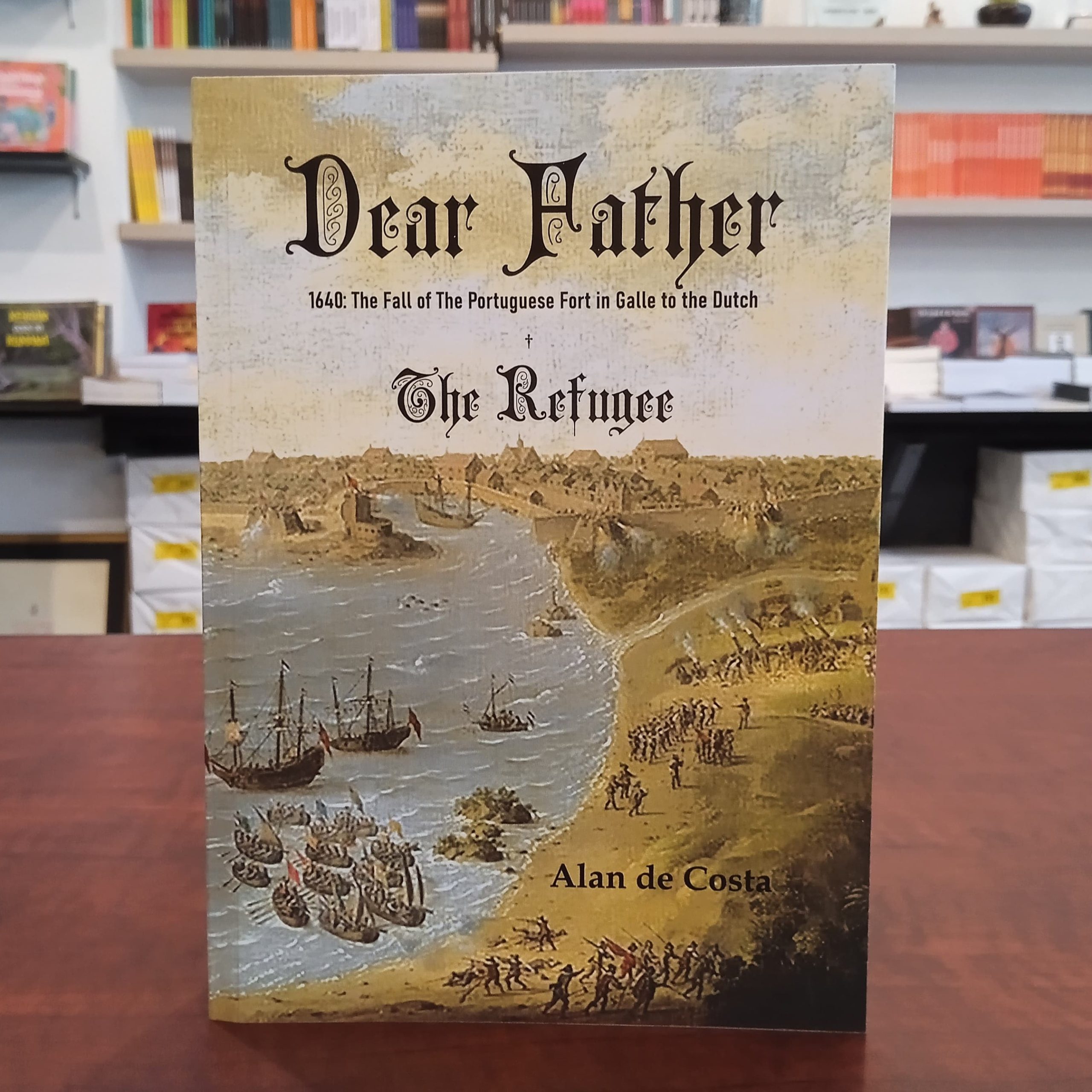
Alan de Costa was born, raised and schooled in Colombo, and left for medical school when he was twenty years old. His parents were both very involved with books and literature – his mother being a writer herself and his father having inherited a large number of books from his father’s library. However, as a child, Alan always read and loved the genre of history, and this particular interest continued into his adulthood. Today, Alan is a published author of “Dear Father and The Refuge”, a historical fiction in two parts, through The Jam Fruit Tree Publications. Alan recalls growing up in a house where there were shelves full of books, and he remembers walking through the house when he was around the age of ten, looking at any title that would catch his eye. One such book that caught his eye was An Historical Relation of the Island Ceylon by Robert Knox.
“As a kid, I was looking only at the pictures in the book, and I remember there was a picture of Rajasinghe II in his finery and many other pictures that Robert Knox was a witness to. I remember reading one line that stuck with me for the rest of my life. Robert Knox called Rajasinghe II a “gloomy tyrant”. And of course, in history we learnt in school, he wasn’t a favourite topic. And I believe that Rajasinghe II was rather poorly represented in our education, even though he was one of the longest-serving kings in Sri Lanka. This was something that was stuck in my mind,” said Alan
Today, Alan reads and studies history related to his own profession as well – surgery. He explained how people generally tend to forget history and the lessons it taught, and would repeat the same mistakes over and over again. Not being a professional writer, he recalled how he had no template when it came to writing, but once COVID struck and lockdown was imposed, it gave him time. It was around the same time Alan left clinical practice and started to continue academic practice. “During this time, I thought one of the stories that might speak to Sri Lanka’s colonial past that hasn’t been done before was the entire early Dutch or Portuguese period. I used whatever information I knew and filled it in with fiction, but informed by what was happening on the international stage,” explained the author.
The warships and the use of cannon and infantry, together with the style of warfare of the Dutch and the Portuguese, all that is used to provide a picture of the fight of the fort and Galle, the beginning and end of it and the people who were involved in it. The characters the author has picked reflect their values and knowledge of that historical period of the mid-17th century, particularly the achievements and how they influenced a lot of aspects in Sri Lanka. The book also shows how the Dutch were different because of the reformation, how the two armies combatted each other and how they did business.
“I was initially clueless when it came to writing historical fiction but once I started writing, I went on and was able to finish the first draft, maybe within six months. And after that, I kept on rewriting it,” said Alan. “Since I like to be a busy person, I was able to be consistent and very fortunately, I had access to my university library and also had my own library, which was part of my father’s and grandfather’s book collection as well.” Therefore, the author had some really fine old books which all helped him in the writing process of “Dear Father”. The main theme in this book is how time changes everything, and some of the facts in this book were looked at 300 years apart through different eyes and also looked at in a different historical context.
Alan describes publishing with The Jam Fruit Tree Publications as very straightforward. He mentions seeing the physical book, printed and finished, as a memorable and surprising moment for him. He further explained how one of the references for these books is the History of the Catholic Church in Sri Lanka, which consists of three volumes of the Portuguese period and two volumes of the Dutch period. The author of these was Father V Perniola SJ, and these were published in Sri Lanka in 1989. Alan acquired these volumes from his father’s library, and they also relate to the evolution of Christian thought between the 17th and 20th centuries, and its impact on the Sinhala populations. The volumes written in the Portuguese times were written in a series of letters, and it’s about the senior priest writing to his boss in Galle. These letters start by saying “Dear Father”, which is how the inspiration for the title of the book came to him. It is also a tribute to the author’s own father. “My father was very keen that I write well, and I remember that he used to send me cuttings from George Orwell on how to be a good writer as well,” reminisced Alan fondly.
The author wrote this book before he thought of who he was writing it for, but he believes he wrote the book for people like himself. “I also think that many people visiting this country might find my book useful and interesting – particularly people from Europe because I talk a lot about the change in European history. By reading this book, I want my readers to realise that there are multiple ways to look at the same story. I also ask the readers to have some compassion for the people whose lives I have described and perhaps for the writer who has written it as well.”
Written by Gayanga Dissanayake