
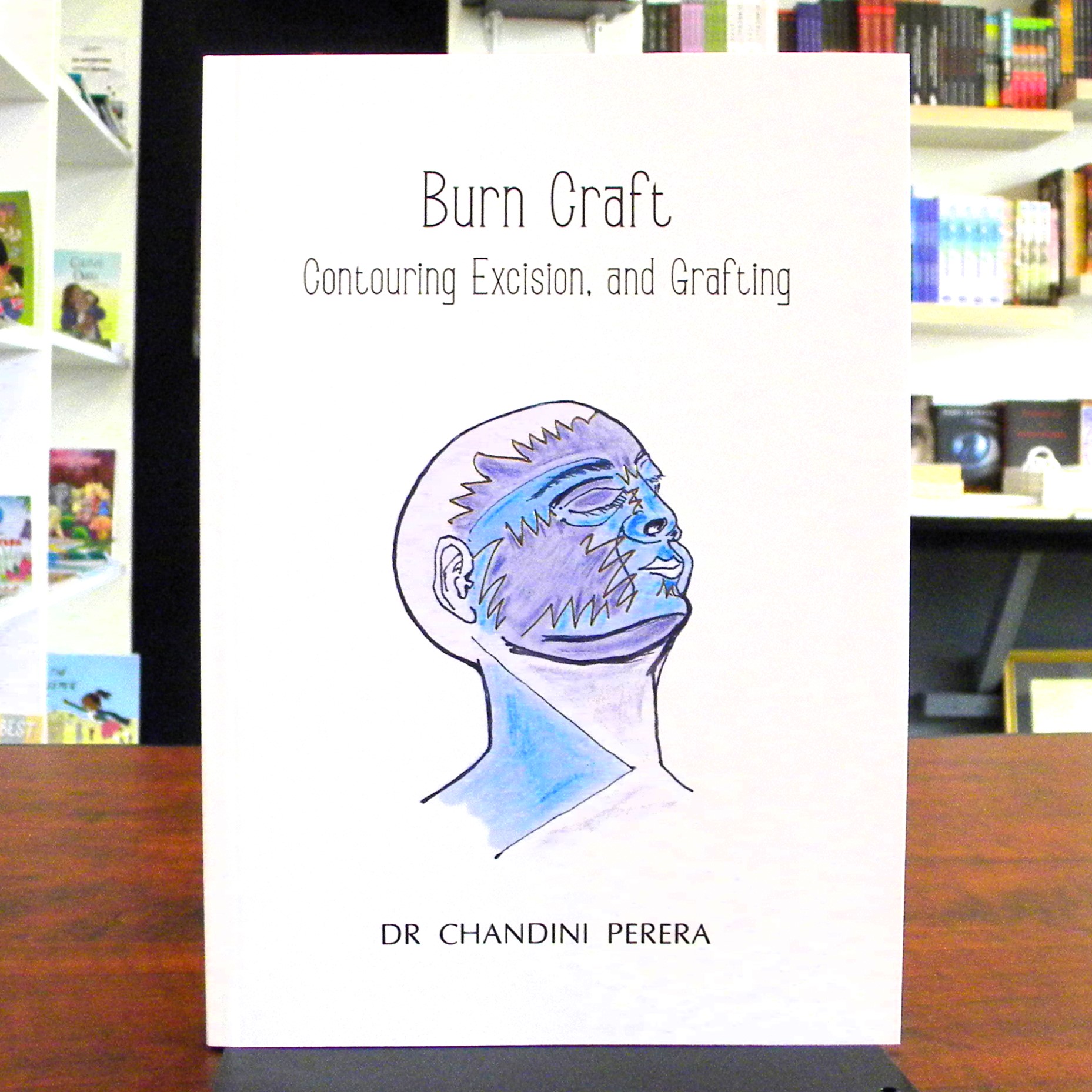
As a plastic surgeon, Chandini Perera ran the Burns and Reconstructive Surgical Unit at the national hospital for the last twenty-four years. It is very unusual for a plastic surgeon to concentrate solely on burns, but because the number of patients was so large, she was working on severe burns for almost her entire career. “Normally, plastic surgeons do other things apart from burns. However, since my workload when it comes to burns was huge, it also became an advantage for me to write my book,” said Chandini. Her book Burn Craft: Contouring Excision, and Grafting was recently published through The Jam Fruit Tree Publications.
“I have literally done this procedure over a thousand times,” said Chandini. “Initially, when I started my career, Sri Lanka was a low-income country, and then it became a middle-income country. So, generally, having a large number of severely burned patients is not something to be embraced. But in a way, it worked out for me in the culmination of this book, since with the large number of patients, I had the opportunity to do this procedure a large number of times and also observe the results over a long period of time,” she explained. She also got to follow up and offer other plastic surgeries if they needed them. Most of her follow-ups are around twenty years, which helped her observe her own technique as well and see whether it got the desired results or not. The photographs that she has shared in this book are from many years ago. Therefore, she knows that this technique works. However, she had some degree of self-doubt when putting it out there as a very new concept to the world.
Normally, when you have a burn defect, Chandini explained that this burn happens in a random pattern. For example, it can cross over a limb, it can cross over a joint, and we can’t control the pattern of how someone is burned. If we follow that burn pattern, we will be putting the graft in a random pattern as well, and the result will also be a random outcome. Sometimes it will work, or sometimes it will recontract and look bad. Normally, we just cut it according to the random burn pattern and put it on the skin. The outcome, therefore, can be random, and many people may get deformities following that. If it’s a joint, instead of the joint being functionable it can get contracted. The surgeons may close the burn wound, but afterwards, you may end up with a deformity.
However, according to Chandini’s technique, even though the burn is in a random pattern, what we have to remember is that the skin doesn’t work in a random pattern. Instead, skin has a definite, predictable and organised pattern. Therefore, when we are grafting, we have to be true to that organisation. If we follow that organised skin pattern instead of the burn pattern, we will get the correct outcome. Even though the burn patterns are random, what Chandini has done in her book is that she has given patterns on how one should align the graft and the scar at every joint and every part of the body. To do that, Chandini has combined well-known plastic surgical procedures with the grafting so that the grafts aren’t being put in a random pattern, and instead are put in a definite, predictable pattern according to the organisation of the skin at the subcutaneous (deep) layer. Therefore, instead of getting a deformity, the scar will blend into your normal contour creatively and functionally.
As an example, Chandini explained how an elbow has wrinkled skin at the back of it, and in the front, the skin is tight and hollow. If there’s a burn around the elbow and we just put skin there, we may close the wound, but it won’t act like your normal skin, and you won’t be able to stretch your elbow, or you may get a deformity. But if we follow the skin pattern when grafting, we will get a normal contour and a normal function, while the scars also settle in nicely. Instead of the graft being tight and tense and deformed, the graft will be relaxed and look good as well.
“Because I’m a first-time author of an original scientific book, I had to make sure and be aware of the fact that I couldn’t share it freely with anybody, which also made it difficult for me to get feedback as a first-time author,” explained the author. “I also wanted this to be a work out of Sri Lanka because all my patients were Sri Lankan, my burn unit was from Sri Lanka, and my patients are from Sri Lanka. Therefore, I wanted this book to be available to countries where there are many burn patients but few resources.” Chandini mentioned how normally people think that if you go to a good burn unit and you get grafted, you will have very good results. But that’s not true. You can survive the burn, but you are not guaranteed not to have deformities and disabilities unless you have been lucky enough for the drafts to have been put in a particular way.
“I have travelled all over the world, from Latin America to almost every continent in the world, and I have seen the terrible deformities people can get after drafting. And if you are poor and live in low-income countries, perhaps if someone is an impoverished person from the slums or from a rural village, a farmer, they are highly unlikely to end up with it,” she said. She explained how if a child has a contracture near the ankle after a graft and the child is of school-going age, they won’t be able to wear shoes and, by default, not go to school since wearing shoes is a requirement. If you have a contracture in your wrist, you may not be able to write. The worst of it all can be facial deformity since children will simply refuse to go to school. If it’s an adult, they will hesitate to socialise as well. “Burns lead to stigma, which can be psychologically very painful and damaging,” said Chandini. “Therefore, I knew that this material had to be out there because even after so many years, this information has only gone out to a particular audience. And people who are working on burns may also not have access to it. Hence, writing a simple book and making it affordable, I wanted the knowledge to become available.”
Though Chandini has presented some of these in scientific meetings, it was an entirely different challenge for her to do it in the form of a book. The quote, ‘truth passes through three stages, first it’s ridiculed, second it’s violently opposed and third, it’s accepted as self-evident,’ applies to her work as well. “My technique has a lot of truth to it, but we aren’t used to it because it is not conventionally taught and accepted. I couldn’t even share my writing with anyone for feedback since it was a risk, as anyone can just grab your original ideas. Therefore, it was also a challenge to keep the original concept as original as it was and then write it as a book,” stated Chandini.
Chandini’s patients also wrote poems to her, one of which she has included at the beginning of her book. “When you are dealing with someone’s severe burns, you realise that some of these patients are creators and authors. It’s very inspiring to know that the hands that you grafted were able to write and create again. Inside my burn patients, there were remarkable people, artists, authors and poets. And when the right grafting contributes to their wholeness, the possibilities in their lives once again become limitless,” she said. She recalled how some of her patients got married a second time, went abroad, found partners, and had children. Their lives are transformed to a point where it’s even hard for her to believe. During the time she was writing this book, she also got the chance to meet some of those people to whom she did those procedures, which she regards as some of the most highlighted moments in her life. She explained how it puts everything into perspective and gives her endless satisfaction. “I would like to compare this practice to the Japanese art of repairing broken pottery with gold called “kintsugi” since I believe that the burn victims’ lives become more valuable after the grafting procedure. I wholeheartedly hope that this book would generate a valuable and most important conversation about grafting and that it would open up many avenues of research and new ways of thinking surrounding burns and burn victims,” said the author.
Words by Gayanga Dissanayake