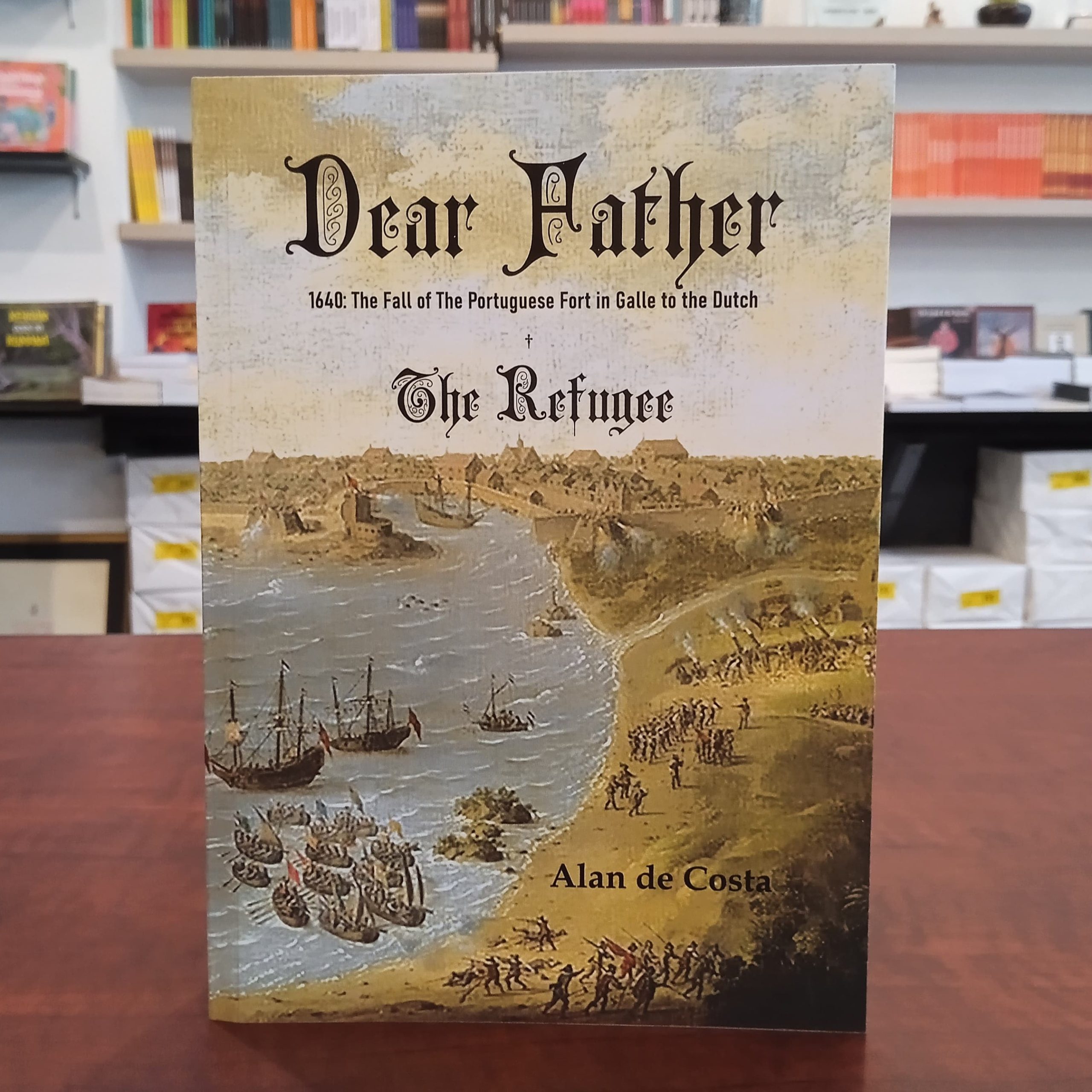
Dear Father – 1640: The Fall of The Portuguese Fort in Galle to the Dutch
LKR 4,000.00
11 in stock
| Weight | .640 kg |
|---|---|
| Dimensions | 21 × 15 cm |
| Author | |
| Format | Paperback |
| Language | |
| Pages | 496 |
| Publisher |
This is a work of historical fiction in two parts. In book one, 'Dear Father', the participants in this story would have spoken Portuguese, Creole, Sinhalese, Dutch, Arabic and Tamil, and a lack of a shared language would have contributed to misunderstanding and suspicion.
In book two, 'The Refugee, largely set in Italy, Italian and Venetian dialects feature, as well as Australian.
Dear Father: The history relates to the fall of the Portuguese fort in Galle, Ceylon (now Sri Lanka) to the forces of the Dutch East India Company (VOC) allied with the Sinhalese King Rajasinghe II, in 1640.
The fiction describes two journeys and two sets of characters: The first is the journey of the Portuguese painter Dias, who is sent out from Lisbon on a commission to Galle, to paint portraits of two famous Catholics close to the heart of the King, a Priest and a Soldier. War and the Inquisition get in the way of these tasks, but Dias paints a great deal of the country and its people.
The second involves the journey of Koster, a VOC operative from Amsterdam to the East Coast of Ceylon, and a hazardous journey overland to the hill capital of Kandy. He is able to negotiate and sign a treaty with the Sinhalese for a successful military alliance against the Portuguese.
The Refugee: A young Ceylonese, Anthony Markus, arrives penniless in Australia via a circuitous route in 1970. He completed a Master's at the University of Canberra in English Literature. He then gets a job with The Australian Weekly magazine and is posted to Rome in early 1971. He is asked to go to Venice to report on the first solo exhibition of Dias’ works. Shortly before this, the first violent Marxist revolution breaks out in Ceylon, where his family are involved. Markus has had a particular childhood which allows him to absorb aspects of history, art, and music, and also some of the prejudices of the times. He also learns of his own relationship, through art and history, to the Portuguese soldier who Dias travelled a long way to paint.
Click on the Kindle logo below to get this title as an e-book: