
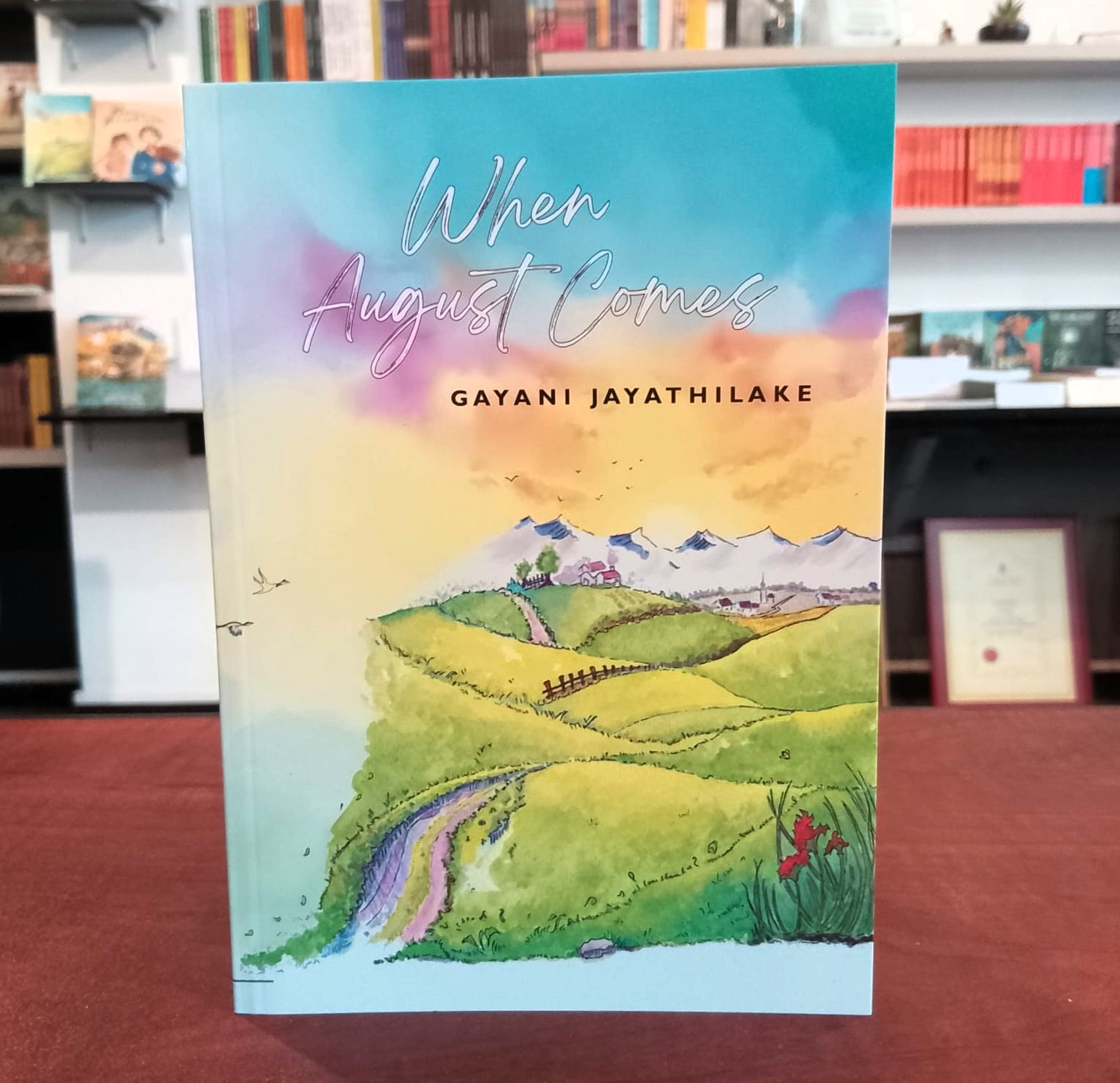
‘I feel I have finally arrived at the right port after many detours. It’s impossible not to write for me. Most of my tales derive from my fascination with in-between places,’ said Gayani Jayathilake. Gayani’s writing journey stems from a deep love for reading since she grew up buried inside books. She vividly remembers her grandmother’s house, where she lived during school holidays. There was a nook under the giant jackfruit tree that housed mini insect worlds, a shortcut through the paddy fields they loved to take and her aunt’s kitchen, always accessorised with puddings. She noticed how all these scenes were instilled inside pages full of words somewhere. She believes this is why she writes literary fiction that does not strictly adhere to the conventional boundaries of genre fiction or nonfiction. Today, her lifelong habit of writing has made her the author of When August Comes, published by The Jam Fruit Tree Publications.
‘I come from a long family line full of strong female characters. My father used to praise my mother, jokingly calling her “iron lady”. Today, as an adult, I know he wanted his two daughters to hear it,’ recalled Gayani lovingly. Her path originates from where parents celebrated them for who they were and wanted them to follow their dreams. ‘It was really a show-and-tell situation with my parents. As a result of that, today I am exactly where I want to be. And so is my sister,’ said the author.
When asked about the inspiration for When August Comes, Gayani mentioned how her father created a magical garden after retirement. Her father loved his job so much that we all worried if he would be fine after retirement. It was his garden that gave him new hope. Her mother, too, stepped in every now and then after she came back from the office to help out. It was so fascinating that after he suddenly passed away, Gayani began describing it to those who had not seen it. Her fear of forgetting the minute details in it made her write about it on paper. When she left her career and country after marriage and did not know what to do and where to begin, her husband’s words, “Why not do what you like doing best?” were like an epiphany for Gayani. It was as if it had been under her nose the entire time. ‘My writing became my queendom after that. My pen became the voice to my introverted self. That is how the scribblings I made of this magical garden turned into my first novel, When August Comes. At first, it was written only for my reading pleasure and was not meant to be published. But in the process, I noticed how it calmed me, and I wanted to give that to the others. That is how the life of Noam Hubert came about, my own life experiences that later turned into a fictional tale.’
These days, Gayani is writing her second novel and filling in gaps inside her short story collection now and then. Most of Gayani’s writing is character-driven, and it’s those characters who tell her what to write. ‘I just need to show up early in the day. That’s all my characters ask for because that’s when all the magic happens. Then I gracefully step into their shoes and live their life momentarily,’ said Gayani. Even though the author does not have a clear-cut routine now with these projects, she did have one with When August Comes. She made herself start at 4 am and complete the targeted word limit for the day before getting out of the chair. ‘I think that book disciplined me to become who I am today. To write consistently, search for my own style and never get distracted away from my writing.’
Ideas just bubble out of the author’s mind, and she doesn’t know where they come from. All she knows is that she must write them down. Otherwise, the words and images pile up. So Gayani has aptly placed notebooks everywhere she might need them. ‘I have notebooks in every bag so I can write on the move, on the bedside table to write the best ideas that come during sleep, in pockets, by my meditation cushion. There are times I look back and read lines I wrote and cannot remember if I did that. It’s like I was in a trance when I wrote it. I was completely living another character’s life then. I think other writers can relate to this,’ explained Gayani.
Gayani noted how gripping narratives connect with people and how stories have such power. During her teaching days in Sri Lanka, she noticed how children and adults alike listened more through examples and stories rather than just being told something directly. Therefore, she began weaving in messages through plot twists. She made it a habit to throw in major topics that troubled her, like biodiversity loss and deforestation, inside sugar-coated lines of rhyme. She also squeezed in critical details like climate change inside chapters of this novel, so it is noticed as you listen to the rhythm of the countryside.
‘My style of writing, be it for novels, short stories, flash fiction, creative nonfiction, or hybrid prose poetry, is mostly literary fiction. My love for describing something through imagery and symbolism was used heavily throughout this novel. When I’m talking about a certain flower’s growth pattern, I’m really talking about the change in seasons. And if I’m talking about how late it was to bloom, then I’m really talking about the aftermath of climate change,’ said the author.
Gayani explained how she had this bad habit where she begins multiple new projects over existing ones that are not finished. This disrupts the calm as she divides her time of the day to do multiple projects. The fact that they are each completely different in setting, theme, pattern and sometimes style does not help either. The other difficulty was getting the cover done. She recalled how she searched high and low for months and even went through a few finished covers by artists that did not work out for her. The cover page holds deep emotional significance for a novel, so Gayani ultimately illustrated it herself, pouring her own artistic talent and personal touch into the design. ‘I have this funny habit of drawing an image for chapters as I go along. So I had several images already drawn for several chapters. When the cover was not happening, I drew it myself. Jeremy, my publisher, helped a great deal here, too. I showed him my rough sketches, and his words were very encouraging,’ mentioned Gayani.
One thing that changed in the novel after the beginning chapters was the setting. The author explained how the incidents she spoke of emerged from Sri Lanka. The plants, environment, and culture were all there. That is how the story began, like most of her other projects. But a novel, unlike a short story, felt like a deep ocean full of words, where she had to keep on swimming for months on end to reach any completion. As she sat in a foreign land, immersed in the words of a distant place, there were times when she wanted to stop or go back. But stopping midway wasn’t an option for Gayani. Therefore, she changed the setting. ‘I had to feel and see it all in my surroundings to write the novel. This is why Noam’s garden is set in a different country. My most favourite research point was learning new names and life patterns of trees and plants, seasonal changes, how climate change impacted them within that setting,’ said the author. Gayani’s husband, being a nature enthusiast himself, helped her a great deal in this. She, too, had moved to a foreign land with this story and felt like she grew with it.
For Gayani, publishing this book was like a stroke of luck. ‘I had sent out several emails to several publishers in Sri Lanka to talk about my short story collection that had stories that revolved around Sri Lankan lives. One publisher replied within seconds, and that was The Jam Fruit Tree Publications. And I’m glad they did. Since my novel was completed before the short stories, I gave it to them. I think it was the characters in the book that chose them, not me. From there onwards, it felt like my book was home. I’m glad I found The Jam Fruit Tree Publications because it made the publishing process I had imagined to be very complicated seem so easy for me,’ said Gayani.
The author’s interest in in-between places is really based on interconnectedness within nature on a humane level, even if she says it indirectly within the lines. This story is about that connection and understanding how nature has your back before anyone else.
According to the author, another reason to open the doors of Noam’s life for others is to know that we all face unexpected situations just like him. Most of the other characters in her story find their own personal growth and move on as well. Change and transitioning come differently to all of us. Overcoming loss is mindfully mingled with nature to show that you will always have a place to come back to, wherever you go.
‘I was lucky to have a mother who bought five old encyclopaedias after payday, where I kept rereading the stories section full of fables and mythology. I am grateful for my father, who took me to that old street bookshop in Colombo and showed me why I should not stop writing. My sister was the original creator of the passionfruit fairy stories in this book. And I think my husband is the only one I’ve met who owns more books than me,’ said Gayani.
The author explained how, through reading, we become first-hand spectators and, for a moment, live another’s life. We are transformed into retiring chefs, the final breath of a brother, a mouse that nibbled into valuable treasures, a canine that needed care, a fairy in a vine, a loving daughter, a regretting son. Sometimes all these in one book. ‘I believe reading is like showing up for yourself. You connect and be present for every character you meet along the way. The more you read, the more you understand,’ she said. ‘I hope you lose yourself inside my book, and for good reason too.’
by Gayanga Dissanayake